This report follows the official press release based on the mandatory submission to the Department of Antiquities of Cyprus.
See also the 2023 and 2024 excavation results:
https://doi.org/10.30549/opathrom-18-02
Introduction
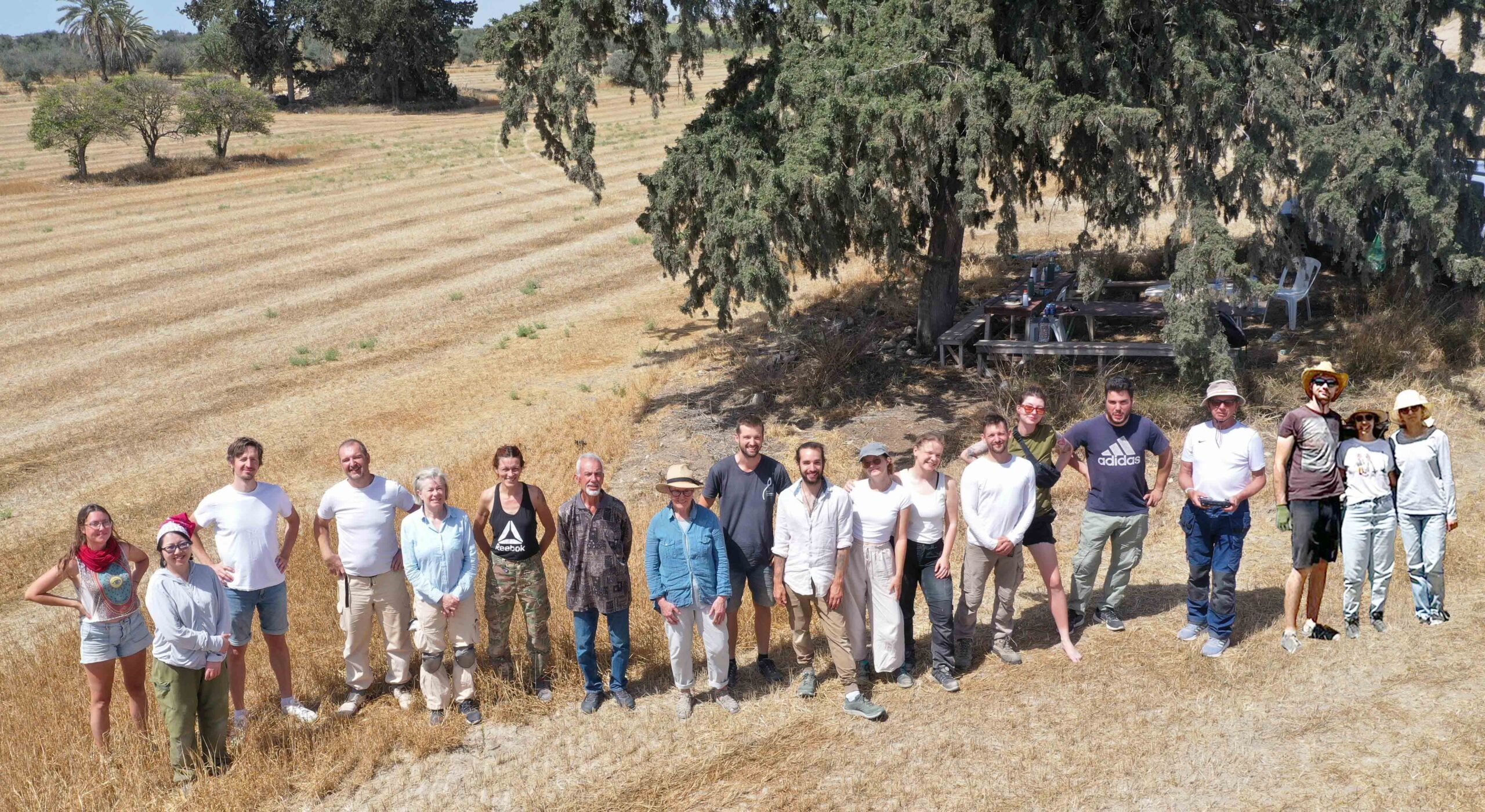
In May–June 2025, a team of local and international specialists and students, led by Professor Peter M. Fischer (University of Gothenburg), conducted excavations in the extraurban cemetery (Area A) of Hala Sultan Tekke on the south-eastern coast of Cyprus. The site, a major urban centre of at least 25 hectares, was founded around 1650/30 BCE and flourished for nearly five centuries before its destruction c. 1150 BCE.
Fieldwork in Area A, guided by geophysical surveys and surface finds, revealed anthropogenic features, including a disused well and two chamber tombs dating to the 14th century BCE. A nearby modern borehole confirmed high groundwater salinity (c. 10 m depth), likely explaining the well’s early abandonment. Although the tomb roofs had collapsed in antiquity, this effectively sealed the contexts, preserving valuable evidence of Late Bronze Age burial practices.
Excavations were carried out in collaboration with Dr Rainer Feldbacher and members of the Swedish mission. Professor Teresa Bürge processed groups of finds at the Archaeological Museum of Larnaka. Bioarchaeological work was conducted by Professor Kirsi Lorentz and her team including Dr Yuko Miyauchi (Cyprus Institute), while Professor Sorin Hermon and his team provided 2D/3D documentation and material analyses.
Results
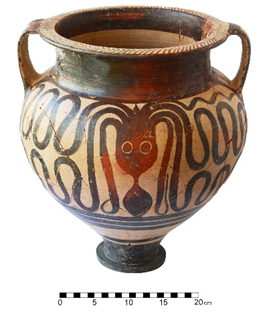
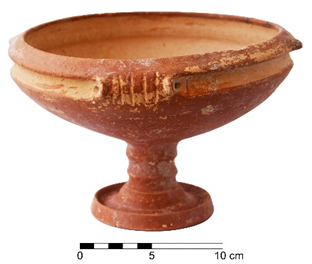
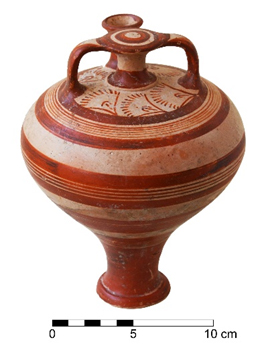
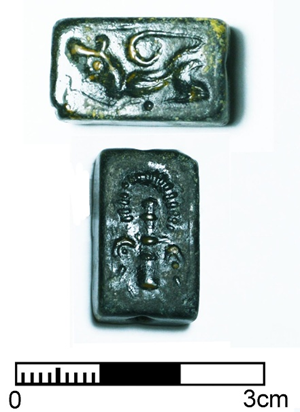
The tombs yielded abundant artefacts, including fine local pottery, tools, and personal ornaments, as well as a range of imports reflecting extensive trade networks. Ceramics originated from the Greek mainland (mainly Berbati and Tiryns), Crete, and other Aegean regions; Egypt supplied ivory objects, calcite vessels, and adornments. Further imports include lapis lazuli from Afghanistan, carnelian from India, and Baltic amber, indicating long-distance exchange via intermediary cultures such as the Mycenaean, Egyptian, and Mesopotamian spheres. Pottery from Nuragic Sardinia corroborates earlier evidence of Cypriot copper exports, especially oxhide ingots.
The city’s prosperity was based on the production and export of copper, facilitated by its well-protected harbour (today’s Salt Lake). Raw materials, namely copper ore and slag derived from the Troodos Mountains, were processed locally. Archaeological evidence, including furnaces and crucibles, attests to intensive intra-urban metallurgical activity. Copper, along with other local products such as purple-dyed textiles, attracted traders from across the Mediterranean, particularly between the mid-15th and late 13th centuries BCE.
The tombs provide key insights into burial customs and social organisation. They were reused over generations, thereby creating an excellent stratigraphy comparable to that of the settlement, with earlier remains carefully rearranged, reflecting strong kinship structures. This prolonged use created stratified deposits crucial for refining chronology, particularly through pottery sequences. Ongoing analyses, including aDNA studies, aim to clarify kinship, health, and demography. Preliminary results indicate individuals of all ages, though few exceeded 40 years, consistent with low life expectancy.
In sum, the finds confirm Hala Sultan Tekke as a major economic and cultural centre in the Late Bronze Age. The richness of the assemblages suggests the presence of elite groups engaged in copper trade and long-distance exchange, while variation in the composition of imported goods among mortuary contexts may indicate specialised roles within these trading networks.
The 2023 and 2024 excavation results are published (open access) at:
https://doi.org/10.30549/opathrom-18-02
Selected finds from 2025
Acknowledgements
We are especially grateful for the continued interest and encouragement of Professor Vasiliki Kassianidou, Deputy Minister of Culture, whose support has been instrumental to the success of this long-term project. The expedition also extends its gratitude to Dr Giorgos Georgiou, Director of the Department of Antiquities of Cyprus, for granting the excavation permit. We further thank H.E. Martin Hagström, Ambassador of Sweden in Nicosia, and the Cyprus Institute for their steadfast collaboration and support.
Special thanks are due to colleagues who provided expert advice across a range of fields: Professors Manfred Bietak (Egypt), Timothy Clayden (Mesopotamia), Jürg Eggler (scarabs), Reinhard Jung (Italian bronzes), George Papasavvas (copper–gold exchange), Vassiliki Pliastika and Laerke Recht (Mycenaean finds), Cemal Pulak (connections to the Uluburun shipwreck), David Reese (faunal remains), and Dominika Kofel (plant remains).
We are particularly indebted to the institutions whose generous financial support made this work possible. The project was primarily funded by the Royal Swedish Academy of History and Antiquities in Stockholm (Enbom Foundation for fieldwork) and the Cypriot Leventis Foundation (for aDNA research). Additional support was provided by INSTAP—special thanks to M. H. Wiener and Tom Brogan—and by the Royal Society of Arts and Sciences in Gothenburg (KVVS).
Finally, we extend our sincere thanks to all participants, whose dedication and hard work have been fundamental to the project’s success.